

Long before the first computer hummed to life, a nineteenth-century mathematician named Ada Lovelace envisioned what these machines could truly become. Born Augusta Ada Byron on December 10, 1815, she was the only legitimate child of the poet Lord Byron, though she never knew her father, who left England shortly after her birth. Raised by her mother, Lady Anne Isabella Milbanke, Ada was deliberately steered toward mathematics and science, her mother fearing that poetry and imagination might lead her down her father’s turbulent path. As fate would have it, it was precisely the combination of mathematical rigor and creative imagination that made Ada Lovelace one of the most remarkable minds in history.
Ada’s intellectual journey accelerated dramatically when, at the age of seventeen, she met Charles Babbage, a mathematician and inventor who had conceived of a mechanical computing device called the Analytical Engine. Where others saw a sophisticated calculator, Ada saw something far grander. She understood, with extraordinary clarity, that a machine capable of manipulating symbols according to rules could do far more than arithmetic. It could compose music, produce graphics, and solve problems of virtually any complexity, provided the right instructions were given to it. This insight, which she articulated decades before the modern computer existed, is why Ada Lovelace is widely regarded as the world’s first computer programmer.
Her most enduring contribution came in 1843 when she translated an article by the Italian mathematician Luigi Menabrea titled “Sketch of The Analytical Engine Invented by Charles Babbage.” Rather than simply translating the French text into English, Ada appended a set of her own notes that were nearly three times the length of the original article. These notes, labeled A through G, contained detailed explanations of how the Analytical Engine worked, and more importantly, Note G contained what is now recognized as the first published algorithm intended for execution by a machine. The algorithm described how the Analytical Engine could compute the Bernoulli numbers, a sequence of rational numbers that appear throughout mathematics in areas ranging from number theory to calculus.
The Bernoulli numbers are a sequence of fractions that can be computed recursively, meaning that calculating any given Bernoulli number requires knowing all of the Bernoulli numbers that came before it. Ada’s algorithm used a formula that expressed B(n) in terms of previously computed values, relying on binomial coefficients and factorials to structure the calculation. Specifically, she derived that B(n) can be computed as the negative sum, divided by (n+1), of each binomial coefficient C(n+1, k) multiplied by the corresponding B(k), for all k from zero to n minus one. Starting from B(0) equals 1 and B(1) equals negative one half under the modern convention used by most contemporary textbooks, this recursive process can generate any Bernoulli number to arbitrary precision. What makes Ada’s achievement so astonishing is that she worked out these steps for a machine that was never actually built, writing executable instructions for a computer that existed only in blueprints and ambition.
Ada Lovelace died on November 27, 1852, at just thirty-six years old, the same age as her father at his death, from uterine cancer. She did not live to see her vision realized. Yet her ideas lay dormant rather than lost, and when Alan Turing and others began laying the theoretical foundations of modern computing nearly a century later, they were in many ways catching up to where Ada had already been. Today, the United States Department of Defense named a programming language “Ada” in her honor, and every second Tuesday of October is celebrated internationally as Ada Lovelace Day, recognizing the contributions of women in science, technology, engineering, and mathematics. Her story is a reminder that truly transformative ideas can arrive long before the world is ready for them.
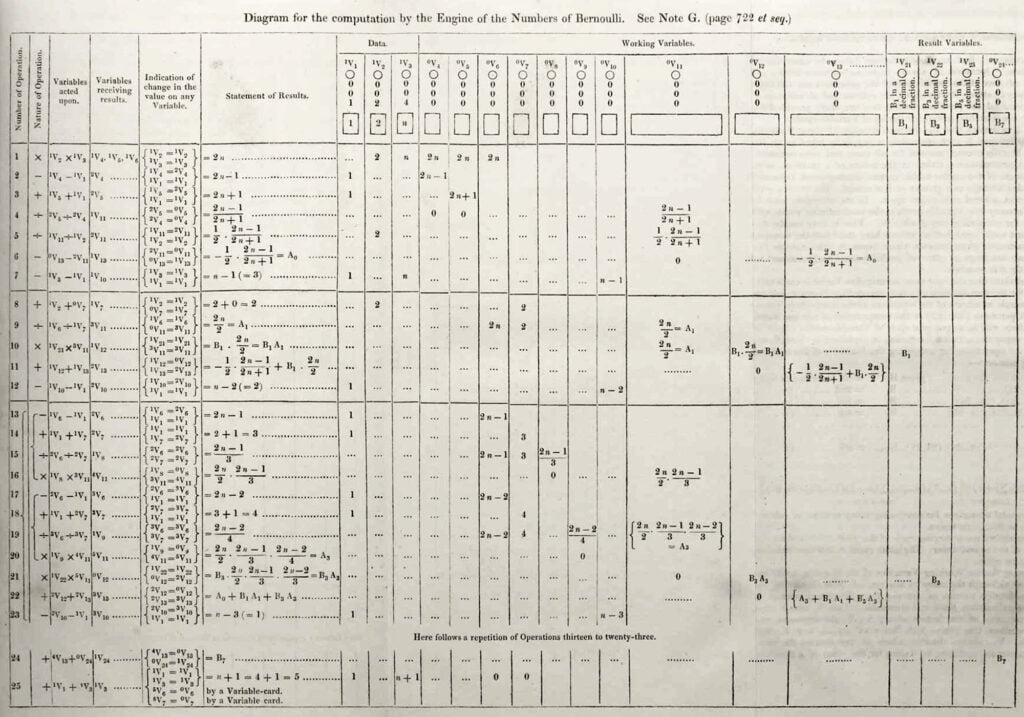
Diagram of an algorithm for the Analytical Engine for the computation of Bernoulli numbers, from Sketch of The Analytical Engine Invented by Charles Babbage by Luigi Menabrea with notes by Ada Lovelace. The steps are describing how the analytical engine would compute B8, which she called B7 in her notation. (Source: Wikimedia Commons)